Sustainable stair renovation in 2026
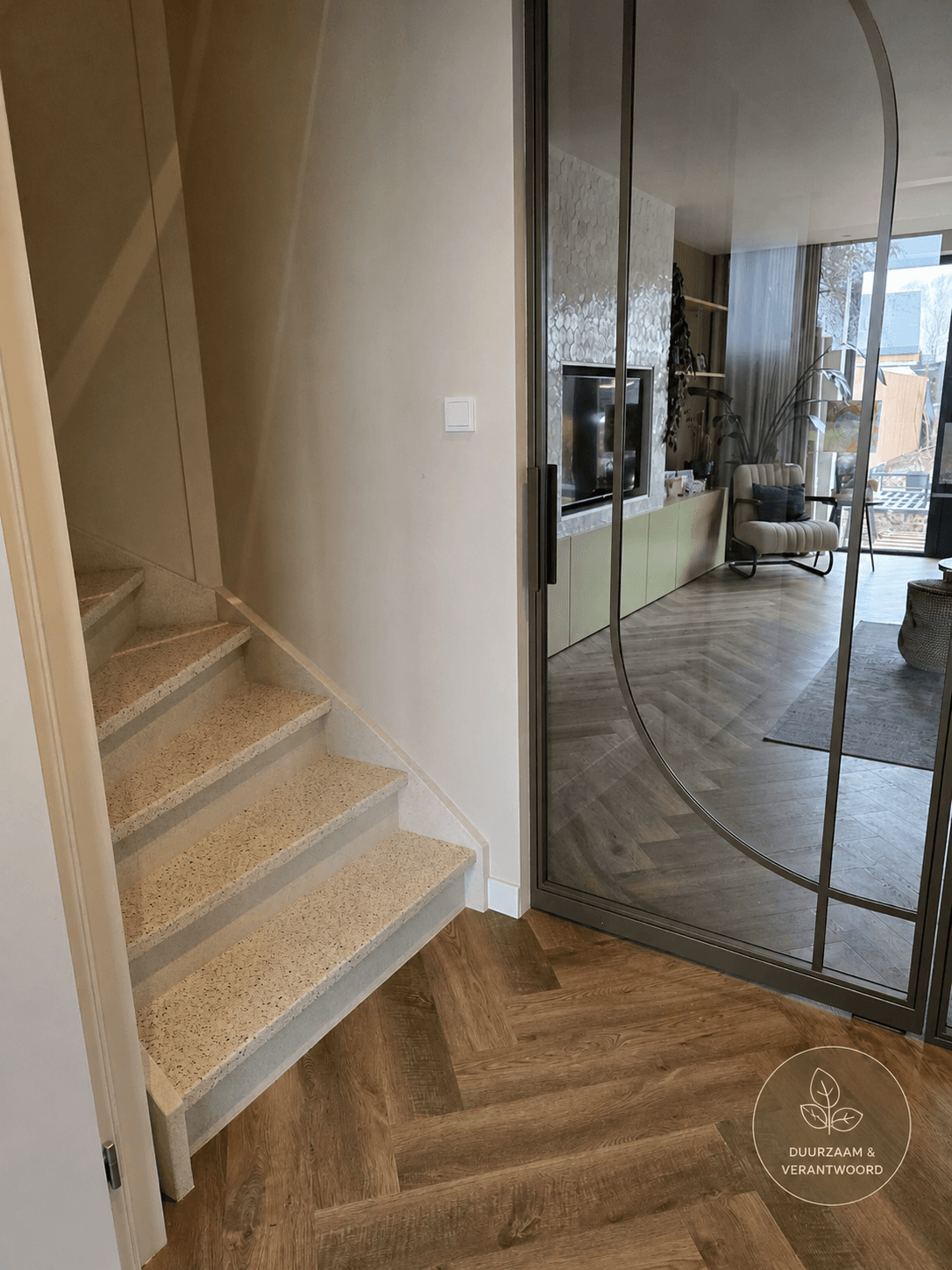
Sustainability in stair renovation has long been about more than green labels alone. Service life, emissions, maintenance, and circularity together determine whether a choice is truly sustainable — including for the resident who walks over it every day.
The question that is rarely asked in stair renovation
Many people think of bamboo when they hear "sustainable stair renovation". Or "recycled". Or an FSC certificate. Those associations are understandable — but they miss a crucial part of the sustainability question: how long does the system continue to function well before it needs to be replaced?
A bamboo stair covering that starts to wear after ten years and needs replacing has a higher total environmental impact than a stone composite system that lasts twenty-five years without replacement. That is not greenwashing — that is arithmetic. The production, transport, installation, and waste of a second renovation all count.
Modern sustainability consultants and architects therefore increasingly look at life cycle analysis (LCA): not just what a material is made of, but what it costs over the full period of use. This page explains which factors play a role — and how stair renovation systems compare.
What makes a stair renovation truly sustainable?
Service life
How long does the system function before replacement is needed?
Material origin
Recycled, renewable, or fossil-based? The origin partly determines the environmental impact at production.
Emissions
What substances are released during and after installation? VOC emissions affect residents directly in their daily living environment.
Maintenance
Does the system require aggressive products or intensive care? Maintenance requirements count over the full period of use.
Circularity
Does the existing structure remain intact, or is it demolished? No demolition waste is the most direct sustainability choice.
Healthy indoor air
Does the system contribute to lower VOC levels? Sustainability is not only for the environment — also for the resident.
The three pillars of sustainable stair renovation
Anyone who takes sustainability seriously in a stair renovation looks at three inseparably linked factors. Each of the three can make or break a system — even if the other two score well.
01 — Material & origin
Where does the material come from? Is it renewable, recycled, or based on fossil raw materials? And how is the material strength — does it determine whether the system lasts long enough to fulfil the sustainability promise?
02 — Technical service life
How long does the system function before wear, discolouration, or damage requires replacement? A longer service life means less waste, less new production, and less transport. Service life is therefore the strongest sustainability lever.
03 — Health & emissions
What substances are released during and after installation? In homes, schools, and care environments, attention to VOC emissions, odour, and long-term indoor air quality is growing. Sustainability is not only for the environment — it is also for the people who live in it.
Why "green" and "sustainable" are not the same thing
Imagine: you choose a bamboo stair covering. Bamboo grows quickly, is renewable, and feels natural. A considered choice. But bamboo on a staircase — subjected daily to shoes, heels, sand, and moisture — wears faster than most people expect. After ten years, replacement is necessary.
That second renovation has a price: new production, new transport, new installation work, demolition waste. Add to that the fact that the first bamboo covering has already been discarded. The total environmental impact over twenty years is therefore higher than with a system that simply continues to function throughout that period without replacement.
The most sustainable material is the material that stays in place as long as possible — without being replaced.
That is not an argument against bamboo or other natural materials. It is an argument for honest accounting. Service life is the most underestimated sustainability factor in stair renovation — and at the same time the factor that makes the greatest difference over the full period of use.
Sustainability by material type
The table below compares the most commonly used stair renovation materials across the six defining sustainability factors. The ratings are indicative and based on general market overview and technical product data.
| Material | Type | Service life | Origin | Emissions | Maintenance |
|---|---|---|---|---|---|
| Bamboo | Bio-based | 15–20 years | ✓ Renewable | Average | Moderate |
| FSC Oak | Natural | 25+ years | ✓ Responsibly sourced | Dependent on finish | Moderate — lacquer/oil required |
| HPL / Laminate | Composite | 10–15 years | ✗ Fossil-based | Average | Low |
| PVC / vinyl | Synthetic | 10–12 years | ✗ Fossil-based | Variable | Low |
| Recycled natural stone composite | Circular | 25–30 years | ✓ Residual streams | ✓ Low (SolidLux UV) | ✓ Very low — moppable |
The most overlooked sustainability choice: preserve what is already there
In many traditional stair renovations, the existing structure is removed. Demolished, taken away, disposed of. Tens — sometimes hundreds — of kilograms of material that were once produced, transported, and installed, now becoming waste. Including the CO₂ that was already emitted for that purpose.
Ultra-thin renovation systems work from a fundamentally different philosophy: the existing load-bearing structure is sound. Only the walking surface has aged. By replacing only that — with a system just 4.3 mm thin placed directly over the existing tread — everything else remains intact. No demolition waste. No breaking up. No complete replacement of something that could have continued to serve for years.
That choice sounds like a technical detail. But per staircase it can prevent hundreds of kilograms of demolition material, halve the construction time, and drastically reduce disruption for residents. In an apartment complex of thirty homes, these are no longer marginal savings.
What preserving the existing structure delivers
What this system does well: no demolition waste (the load-bearing structure remains intact), less transport (no removal of heavy material), shorter installation time (no breaking up or levelling required), less disruption for residents (installation often in one day), and a lower total CO₂ footprint per renovated staircase.
Project scale — the impact multiplies
What to keep in mind: for a single home the savings are already noticeable. In an apartment complex of thirty units they are substantial. Per staircase this can mean hundreds of kilograms less demolition material — an impact that only grows as the project gets larger.
VOC emissions and indoor air quality in stair renovation
After a stair renovation, many homes smell different. Not always pleasantly. That odour has a name: volatile organic compounds, or VOCs. They can be released from adhesives, coatings, lacquers, and plastics — and they do not always dissipate quickly.
In homes, care environments, and schools, attention to indoor air quality is growing considerably. Not only for comfort, but also because of health effects from prolonged exposure. Families with young children, people with respiratory conditions or allergies are more sensitive to high emission levels — and a staircase walked dozens of times per day is not a marginal emission source.
Systems with low VOC emissions contribute to a more pleasant indoor environment immediately after installation, less odour in the first weeks, and a durably lower chemical load on indoor air. The Eurofins Indoor Air Comfort Gold certificate is one of the most recognised certifications in this area for construction and renovation systems.
SolidLux UV technology — different from traditional coating
Traditional coatings dry slowly. During that curing process, odour- and emission-forming substances can be released — sometimes for days. SolidLux UV technology works differently: curing takes place through UV-light irradiation, completing the process in seconds. No prolonged drying, no lingering emissions, no odour formation during use.
The result is a closed, extremely wear-resistant surface that is immediately load-bearing after installation — and that requires no aggressive cleaning products to stay clean. That is not only an advantage for the resident. It is also an advantage for the installer who can hand over the same day.
Indoor Air Comfort Gold
Eurofins certification for low emission levels in indoor spaces. Recognised within BREEAM and LEED. Relevant for homes, schools, care environments, and public buildings.
SolidLux UV curing
Curing via UV light in seconds — no prolonged drying, no emission peak after installation. Immediately load-bearing. Extremely wear-resistant closed surface. Low chemical maintenance load.
Wear resistance as a sustainability benchmark
A system that lasts a long time is more sustainable than one that needs to be replaced quickly — even if it is made from "green" material. Wear resistance is therefore one of the most direct benchmarks for the sustainability of a stair renovation.
With a MOHS value of 6–7, recycled natural stone composite is considerably harder than laminate (MOHS 2–3) or PVC (MOHS 2–3). Sand — carried in daily on shoe soles — has a MOHS value of 6–7. This means that a system with a lower MOHS value gradually wears down in practice. Not visible on day one — but certainly after five years of intensive use.
EverStep Solid and GripStep Pro have additionally been tested with the Taber wear test to 10,000 cycles — a standardised method in which a surface is subjected to prolonged mechanical load to simulate intensive daily use. The results confirm preservation of grip, appearance, and surface texture over a long period of use.
| Material | MOHS value | Taber test | Practical consequence |
|---|---|---|---|
| PVC / vinyl | 2–3 | Not standard tested | Visible wear after years of intensive use |
| Laminate / HPL | 2–3 | Not standard tested | Wear on stair nosing visible after 5–8 years |
| Oak | 3–4 | Not standard tested | Character wear — regular retreatment |
| Ceramic tile | 6–8 | Not standard tested | Hard core, vulnerable on impact and grout lines |
| Recycled natural stone composite | 6–7 | ✓ 10,000 cycles (EverStep Solid / GripStep Pro) | ✓ Grip and appearance retained after prolonged intensive use |
Sustainability in construction projects — BREEAM, LEED, and circularity
Within sustainable construction projects, stair renovation is increasingly assessed as part of a broader materials strategy. Certification programmes such as BREEAM and LEED look at material use, emissions, service life, and circularity — and stair systems fall explicitly under these.
Systems with recycled raw materials, demonstrably low emission levels, and long service life can contribute to credits within these programmes. This makes choosing a technically substantiated stair system not only a quality choice, but also a strategic choice for the developer or architect pursuing BREEAM or LEED targets.
In Germany — a market that traditionally places great emphasis on technical certification and long-term material performance — demand is growing for systems that demonstrably meet emission standards, recycling requirements, and long-term performance declarations. Within Mehrfamilienhäuser, care institutions, and public buildings, sustainability and safety are increasingly assessed as a single whole.
For architects, project developers, and sustainability consultants
In project-scale stair renovation, sustainability is measurable — not just declarable. The following questions help in making a substantiated material choice:
Request an LCA report or life cycle declaration — not just a product description
Verify that emission levels are certified by an independent body (e.g. Eurofins Indoor Air Comfort Gold)
Calculate the Total Cost of Ownership including maintenance and replacement frequency — not just the purchase price
Ask whether the existing structure can be preserved — every tonne of demolition waste avoided counts
Check whether the system contributes to BREEAM or LEED credits via material category, emissions, or circularity
Request demonstrable wear resistance — Taber test results are more objective than warranty texts
Sustainability as a technical choice, not a marketing claim
Omnistair chooses an approach in which sustainability is technically substantiated — not just communicated. Recycled natural stone composite as the base material, SolidLux UV coating for low emissions and immediate load-bearing capacity, ultra-thin construction for preserving existing structures, and certified wear resistance for a longer period of use without replacement.
That is not the end point. Omnistair also looks at broader sustainability improvements in production and logistics — more efficient transport, reduced material waste, and future greening of material flows. The focus is on long-term technical sustainability of products and processes, not on quick communication claims.
EverStep
Recycled stone composite, ultra-thin construction. Existing structure remains intact. MOHS 6–7. Stone Naturel, Stone Blend, Terrazzo.
EverStep Solid
NEN 7909, Bfl-s1, Indoor Air Comfort Gold, Taber 10,000 cycles. SolidLux UV coating — low emissions, immediately load-bearing.
Signature
The only completely seamless system in the Omnistair collection. Manually built coating system with SolidLux UV technology. Colour fully bespoke, long-lasting aesthetic performance.
GripStep Home
Integrated anti-slip in recycled stone composite. Moppable, moisture-resistant, durably maintenance-friendly.
GripStep Pro
R11 / NEN 7909, Bfl-s1, Taber 10,000 cycles. Certified sustainability for intensive use and public applications.
Sustainable stair renovation — FAQ
Bamboo scores strongly on renewability and rapid growth. Recycled stone composite scores strongly on service life, abrasion resistance, and maintenance. On an intensively used staircase, a longer service life can ultimately result in a lower total environmental impact — even if the material itself sounds less "green". Sustainability is a sum across the full period of use, not just a snapshot of the origin.
VOC stands for volatile organic compounds. They can be released from adhesives, coatings, and plastics — even after installation. In homes and public buildings, prolonged exposure to high VOC levels can affect respiratory comfort and health. Systems with certified low emission values (such as Indoor Air Comfort Gold) provide greater certainty about indoor air quality immediately after installation.
Traditional coatings dry slowly and can cause odour and emission formation during that process. SolidLux UV technology cures via UV light — in seconds. There is no prolonged drying, no emission peak, and the surface is immediately ready for use. The result is an extremely wear-resistant, closed surface with demonstrably low emission values.
Yes. Modern composites with recycled natural stone achieve a MOHS value of 6–7 — comparable to ceramic tiles and considerably higher than laminate or PVC. Recycled need not be synonymous with less strong. The material composition and production process determine the ultimate performance.
Systems with recycled raw materials, certified low emission values, and long service life can contribute to credits within BREEAM and LEED projects — depending on the specific categories and project requirements. For project-based applications, always request the relevant product documentation and certificates for your sustainability advisor.
Every tonne of material that does not need to be demolished saves production energy, transport, and landfill waste. With ultra-thin renovation systems the existing load-bearing structure remains intact — only the walking surface is replaced. That is one of the most direct ways to reduce the CO₂ footprint of a renovation.
Based on material composition and abrasion resistance (MOHS 6–7) and additional Taber tests to 10,000 cycles, the expected technical service life is 25–30 years under normal to intensive use. That is considerably longer than laminate (8–15 years) or PVC (10–12 years), and comparable to high-quality ceramic applications.
Have the sustainable and technically suitable system for your situation assessed
Sustainability starts with the right choice for the right staircase. An Omnistair specialist assesses your stair type, usage, and sustainability objectives — and provides a substantiated recommendation.
This encyclopaedia page has been compiled by Omnistair on the basis of technical product information and market overview. MOHS values and Taber test results are indicative; exact values may vary by product variant and test conditions. Indoor Air Comfort Gold is a certification by Eurofins. BREEAM and LEED are external certification programmes — the contribution of specific products depends on project requirements and the assessing body. Omnistair is the manufacturer of the EverStep and GripStep system in recycled natural stone composite (patent NL2039653).