Stair renovation for homeowners associations and commercial properties
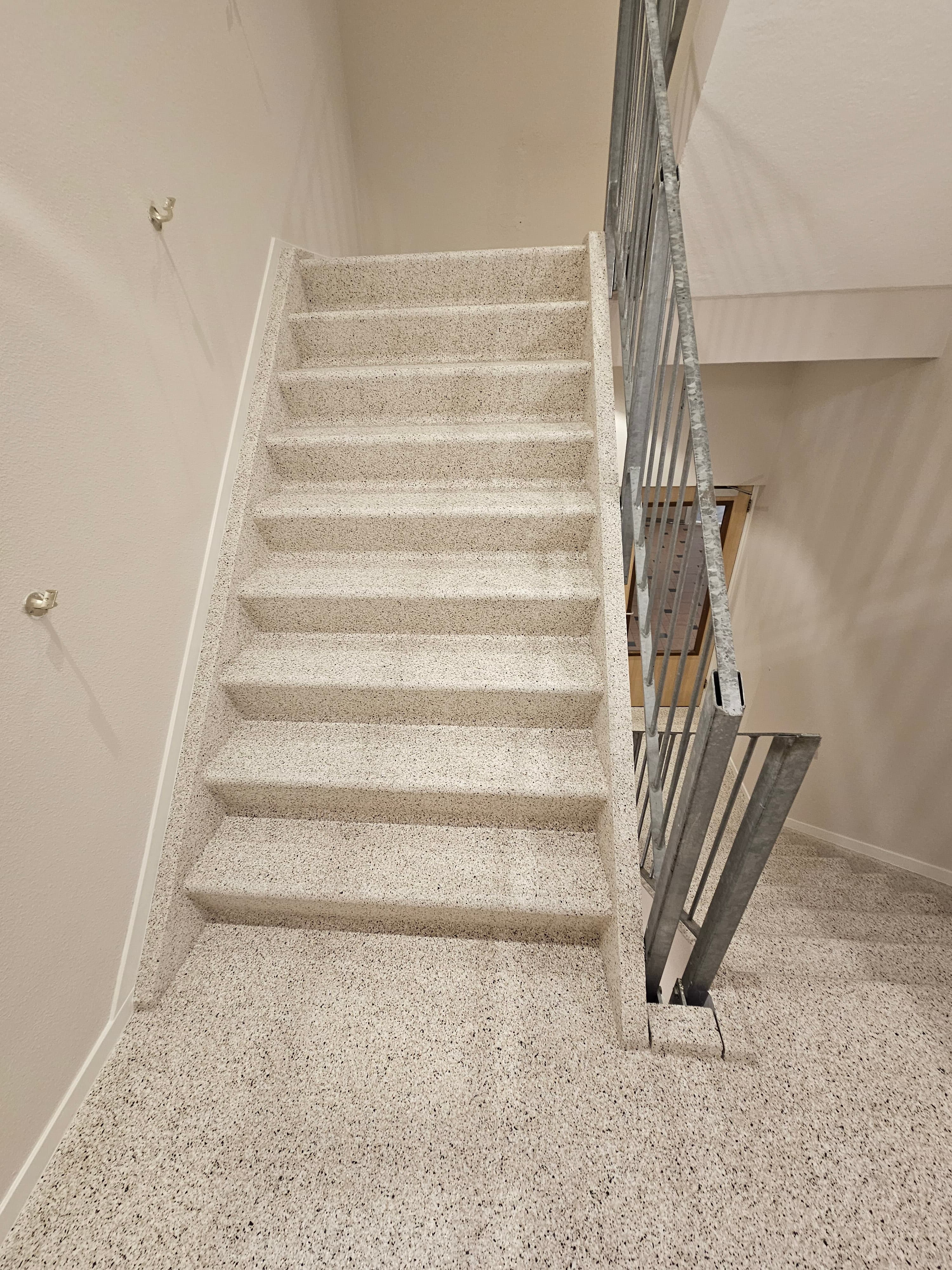
A shared staircase has entirely different requirements than a residential staircase. Safety, liability, maintenance management, and long-term performance together determine whether a renovation is successful — not just on day one, but over the full operating period.
When a staircase is more than a staircase
In a private home, the staircase is a daily route. In an apartment building, it is something fundamentally different: a shared circulation space used by dozens or hundreds of people per day, forming part of an escape route, cleaned by an external company, and for which a VvE (Dutch homeowners' association) board bears liability.
That context changes everything. A strip that comes loose on a residential staircase is an annoyance. On a shared staircase in a flat building entrance, it is a liability risk. A coating that stains after five years on a private tread is a cosmetic problem. In a care facility or public building, the same problem means a management crisis.
Yet many renovations in apartment complexes, VvE (Dutch homeowners' associations), and public buildings are still carried out with systems originally developed for residential applications. That mismatch between system and application is the most common cause of disappointing performance in project-based stair renovation. This page explains exactly what that difference entails — and what requirements a serious project system must be able to meet.
What makes a stair renovation suitable for project use?
The eight decisive criteria for VvE and public buildings
Certified anti-slip — R11 / NEN 7909, demonstrably tested, not merely a commercial label
Fire classification — minimum Bfl-s1 for escape routes and public spaces
Low maintenance load — closed surface that withstands professional cleaning without wear
Long-term wear resistance — demonstrable via standardised tests (Taber 10,000 cycles)
No detachable elements — integrated stair nosing/nosing and anti-slip without loose strips or profiles
Indoor air quality — Indoor Air Comfort Gold for environments where residents permanently reside
Structural substrate preparation — professional adhesion to concrete substrates
Quality assurance — project control, warranty certification, and inspection options
How a small material choice becomes a major management problem
Suppose: a VvE (Dutch homeowners' association) of a 1978 apartment complex has its shared staircases renovated. Budget is the driving factor. A standard coating system also used in homes is chosen. For the first two years it looks fine. Then the problems begin: dark wear paths that can no longer be fully cleaned, wear around the stair nosing, and in the stairwell on the street side — where grit and salt are tracked in during winter — the coating starts peeling in the third year.
The VvE has it renovated again. Again the lowest tender price. Again the same system. Two years later, the same story. After eight years the VvE has paid three times for the same problem, and residents have endured the disruption of renovation three times.
A VvE that chooses on purchase price pays on average twice. A VvE that chooses on Total Cost of Ownership pays once — and properly.
That is not the contractor's failure. It is the consequence of applying a system outside the scope for which it was developed. A residential system on a project staircase is as misplaced as a passenger car on a construction site.
The concrete laitance — why many coatings come loose on concrete staircases
Many VvE (Dutch homeowners' associations) see the pattern: a painted or coated staircase starts to peel after two to three years. The coating detaches — not randomly, but precisely at the most heavily loaded points: the stair nosing, the central walk line, the corners at the risers. It is repainted. The same problem recurs.
A common technical cause is the concrete laitance — also known as cement skin or laitance. During the curing of concrete, a thin, weak cement layer rises to the surface. This layer has no structural strength: it consists of fine cement dust that detaches from the load-bearing concrete core. When a renovation system is applied to this layer without prior mechanical preparation, it adheres not to strong concrete but to a weak intermediate layer.
Under the load of daily intensive use — foot traffic, vibrations, moisture, temperature fluctuations — that intermediate layer eventually gives way. It is not the renovation system that detaches, but the layer beneath it. And that pattern repeats with every subsequent renovation applied to the same substrate, unless the cause is addressed.
Professional substrate preparation — why it cannot be skipped
Diamond grinding or dust-free sanding mechanically removes the concrete laitance
Shot blasting opens the concrete pores for maximum adhesion
Primer bonded to healthy, load-bearing concrete — not to laitance
Moisture measurement before application — concrete that is too wet always causes problems
Documentation of substrate preparation as part of the warranty dossier
Building movement and elastic bonding
A building moves continuously. Temperature differences, settlement, traffic vibrations, and daily use cause micro-movement in the structure. Rigid systems — coatings or adhesives without elasticity — cannot absorb that movement. Over time, cracks, detaching sections, and stress points develop precisely at the most heavily loaded zones.
Omnistair EverStep Solid, Signature Solid, and GripStep Pro are combined with structural elastic bonding that absorbs micro-movements of the structure. This is particularly relevant in older apartment complexes, gallery-access flats, and existing commercial properties — where building movement is greater than in modern new construction.
Escape routes, fire safety, and the requirements that actually apply
A staircase in an apartment building is in most cases part of the escape route. That makes it fundamentally different from a residential staircase — even if the daily function is the same. During an emergency, use changes completely: larger groups, more urgency, less control, moisture from sprinklers or fire hoses, and reduced visibility due to smoke.
In those circumstances, grip and fire behaviour of the tread surface are not nice-to-haves but a direct safety factor. A tread surface that provides adequate grip under normal conditions may fall short in wet evacuation situations. And a material with an unknown fire classification can form an uncontrollable risk in an escape route.
NEN 7909 / R11
Highest anti-slip classification for staircases in professional and public environments. Certified grip also under wet conditions — not only in dry use.
Fire class Bfl-s1
European classification for floor and stair systems. Very limited contribution to fire spread, very limited smoke development. Required for escape routes in apartment complexes and public buildings.
Indoor Air Comfort Gold
Eurofins certification for low emission values in indoor spaces. Relevant for environments where residents permanently reside — apartments, care, schools. Contributes to BREEAM and LEED.
Which requirements exactly apply is always dependent on building type, use function, escape routes, and project specifications. A specialised advisor or installer determines per project what applies on the basis of the Dutch Building Decree (Bbl) and project-specific fire safety requirements.
Commonly used stair finishes in apartment complexes and commercial properties
The following comparison is based on behaviour in project applications — not on product descriptions but on practical performance under intensive daily use.
| System | Project load | Anti-slip | Maintenance | Fire class | Build-up height |
|---|---|---|---|---|---|
| Painted staircase | Limited | ✗ Limited / unknown | High frequency | ✗ Often unknown | Very thin |
| Standard coating system | Light | Depends on grit | Regular recoating | Variable | Thin |
| Epoxy / coating with broadcast aggregate | Good | Possible | Risk of gloss wear | Variable | Thin |
| Thick PVC / wood-look | Reasonable | Possible | Grain retains dirt | Dependent | Medium |
| Thick overlay treads | Good | Often loose strips | Joints / profiles | Dependent | High |
| EverStep | Light project use | Integrated | Low maintenance | Applicable for projects | ✓ Ultra-thin |
| EverStep Solid | ✓ Intensive | ✓ R11 / NEN 7909 | ✓ Low — UV-sealed | ✓ Bfl-s1 | ✓ Ultra-thin |
| Signature | Light project use | Integrated | ✓ Seamless — low | Applicable for projects | ✓ Ultra-thin |
| Signature Solid | ✓ Intensive | ✓ R11 / NEN 7909 | ✓ Seamless UV-sealed | ✓ Bfl-s1 | ✓ Ultra-thin |
| GripStep Pro | ✓ Intensive | ✓ R11 / NEN 7909 | ✓ Sealed — low | ✓ Bfl-s1 | ✓ Very thin |
Indicative overview based on project performance. Final suitability depends on specific project, substrate, and intensity of use.
Why maintenance load is the biggest cost that VvE underestimate
In an apartment building, a shared staircase is cleaned on average more frequently than a residential staircase — and with more intensive methods. Professional cleaning crews use industrial cleaning machines, higher concentrations of cleaning agents, and higher water pressure. Systems designed for residential use are structurally not built for this.
An open coating system that lasts five years in a home may already show visible wear in a VvE stairwell after two years — not due to a poor product but due to a wrong application assessment. And the additional cleaning required due to dark wear paths and dirt penetrating the structure costs more per year than the purchase price difference between a basic product and a project product.
The UV-cured surface of EverStep Solid, Signature Solid, and GripStep Pro is specifically developed for this use: a sealed top layer that bonds less quickly with dirt, withstands professional cleaning without coating degradation, and where anti-slip values are maintained even after repeated cleaning cycles.
MJOP optimisation — stair renovation as part of building management
Within the multi-year maintenance plan (MJOP) of a VvE or housing corporation, stair renovation is typically scheduled based on condition measurement. A condition measurement according to NEN 2767 provides insight into the technical state of building elements — including circulation spaces and stair finishes. Systems with a demonstrably longer service life and lower maintenance frequency extend the maintenance cycle and reduce the contribution to the reserve fund required for interim retreatment.
This makes material selection in stair renovation also an operational decision. A system that lasts ten years longer and requires fewer cleaning hours per year has a direct impact on the building's operating budget. Housing corporations and property managers who apply a sustainable renovation vision — focused on extending the life of existing buildings, circular renovation, and reducing demolition waste — find an additional argument in this for ultra-thin renovation systems that leave the existing structure intact and place less burden on the reserve fund.
Entry zone — the forgotten cost item
The largest share of contamination on a shared staircase does not come from the residents themselves, but from the entrance. Sand, grit, street dirt, and small stones are tracked in under shoes — and these cause abrasive wear on the walk line of the lower treads. A good entrance mat or dirt-trap zone at the entrance significantly reduces the maintenance load on the staircase, regardless of which system has been chosen.
Renovation of existing steep staircases in former industrial housing
Case — Bodegraven: Social housing above a former timber factory
At a renovation project in a former timber factory in Bodegraven — where social housing has been realised above the commercial space — a typical problem arising from existing construction presented itself. The staircases were relatively steep, the treads shallow, and they practically no longer met the desired safety and maintenance requirements.
A completely new stair structure was not a realistic structural solution: too invasive, too costly, and structurally unnecessary — the load-bearing structure was still fully intact. Renovation with EverStep Solid was chosen — ultra-thin overlay treads of recycled stone composite, applied directly to the existing treads.
The result:
Integrated R11 / NEN 7909 anti-slip — also under wet conditions
Improved moisture resistance through sealed UV surface
Maintenance-friendly surface suitable for professional cleaning
Fire class Bfl-s1 — suitable for escape route application
No structural intervention — construction fully preserved
Minimal resident disruption due to short installation time
Staircase and landing as one architectural whole
In modern apartment complexes and commercial properties, the staircase is increasingly seen as part of the total circulation space — not as a separate element. Architects, VvE (Dutch homeowners' associations), and property managers look at unity between staircase and landing, consistent material experience throughout the building, and maintenance of the full circulation route as a system.
Omnistair systems are not limited to stair treads. The same materials and finishes are applicable to landings, entrances, gallery walkways, porticos, and surrounding circulation floors. This creates one coherent architectural whole from entrance to upper floor — consistent in appearance, consistent in maintenance, and consistent in technical performance.
This approach also aligns with the broader trend in building management: no longer treating circulation spaces as the back of the building, but as the first impression for residents and visitors. In an era where quality of life, ESG reporting, and property value increasingly converge, the condition of shared spaces is a direct reflection of the quality of the property portfolio.
For VvE board members, property managers, and project architects
Stair renovation in apartment complexes and public buildings is a management issue, not an aesthetic choice. The decision made today determines maintenance costs, cleaning load, and liability risks for the next ten to fifteen years.
Always request official test reports — "anti-slip" as a commercial term is insufficient in the event of an incident
Check the fire classification per system: not every system that looks suitable has a certified Bfl-s1 classification
Have the substrate professionally prepared before renovation — laitance is the most common cause of premature detachment
Calculate Total Cost of Ownership: purchase price + cleaning costs + retreatment over ten to fifteen years — not just the lowest bid
Link material selection to the MJOP: a system with a longer maintenance cycle lowers the annual reserve fund contribution
Ask about elastic bonding in older buildings with more structural movement
Check whether the choice aligns with a sustainable renovation vision: extending life of existing buildings, circular renovation, reducing demolition waste
Document the applied system with certificates and test reports as part of the building dossier — relevant for future NEN 2767 condition measurements
Consider an entrance mat zone at the entry — this significantly reduces abrasive contamination on the lower treads
Request periodic inspection options and maintenance protocol as part of the tender
Which system suits which project?
Omnistair offers multiple systems for project applications, each tailored to a specific combination of use intensity, architectural requirements, and technical specifications.
EverStep Solid
Ultra-thin overlay treads for intensive daily use. Integrated stair nosing, sealed UV surface, Taber-tested. For apartments, VvE (Dutch homeowners' associations), commercial properties, and social housing.
Signature Solid
Fully seamless coating system for intensive project use. No joints, no strips, no transition profiles. UV-sealed surface with certified safety performance.
GripStep Pro
Certified anti-slip solution for concrete staircases, exterior stairs, gallery staircases, and intensive project applications. Also suitable for staircases where only the walking surface is treated.
EverStep / Signature
For high-end residential construction and luxury apartment complexes where architectural appearance is central alongside low maintenance. Stone Naturel, Stone Blend, and Terrazzo.
| Situation | Recommended system |
|---|---|
| Intensive circulation spaces VvE | EverStep Solid |
| Seamless design finish commercial property | Signature Solid |
| Professional anti-slip concrete staircase | GripStep Pro |
| Luxury apartments — high appearance | Signature |
| Social housing — minimal build-up | EverStep / EverStep Solid |
| Staircase + landing as one whole | Signature Solid / EverStep Solid |
| Public buildings and escape routes | EverStep Solid / Signature Solid / GripStep Pro |
| Exterior stairs and gallery stairs | GripStep Pro |
Stair renovation for homeowners associations and commercial properties — FAQ
There is no universally prescribed anti-slip value for all apartment complexes — requirements depend on building type, function, and the specific escape route and project demands. In practice, R11 / NEN 7909 is used as the standard for professional project applications. This is the highest anti-slip classification for staircases in professional environments and provides the strongest legal position in the event of an incident. Always ask for an official test report.
The most common cause is the laitance layer — a thin, weak cement film that forms at the surface as concrete cures. When a renovation system is applied on top of this layer without mechanical surface preparation, it bonds to a weak intermediate layer rather than to the structural concrete. Under load, that layer gives way. The solution is diamond grinding or shot-blasting the substrate before any renovation work.
This depends on building type, function, and the applicable building regulations. Shared circulation spaces and escape routes typically impose higher requirements than private residential areas. For certainty about the applicable requirements, advice based on the specific building and the Bbl (Dutch Building Decree) is always the authoritative reference.
Add to the purchase price: the annual cleaning costs multiplied by the expected service period, the costs of any retreatment or repairs, and the management burden of complaints and incidents. A VvE (Dutch homeowners' association) system that costs €3,000 more but lasts ten years longer and requires fewer cleaning hours is almost always more cost-effective over the full operating period.
Yes. Omnistair systems are not limited to stair treads. The same materials can be applied to landings, entrance halls, gallery walkways, porches, and adjacent circulation floors. This allows a consistent material experience and maintenance level to be achieved across the full circulation route from entrance to upper floor.
Older buildings have more structural movement: temperature differences, settlement, and vibrations cause small shifts in the construction. Rigid bonding cannot accommodate these movements and may crack or detach over time. Elastic bonding absorbs micro-movements and maintains adhesion even under prolonged intensive use in buildings with greater structural dynamics.
Have your project technically assessed by an Omnistair specialist
Every project situation is different. An Omnistair specialist assesses your building, substrate, intensity of use, and certification requirements — and advises which system best suits technically and economically.
This encyclopaedia page has been compiled by Omnistair on the basis of technical product information, practical experience, and market overview. Regulatory information is indicative — the applicable requirements per project are always dependent on building type, function, and local building regulations. Omnistair is the manufacturer of the EverStep, GripStep, and Signature system in recycled natural stone composite (patent NL2039653). The Bodegraven case study is based on a completed project.