Stair renovation maintenance
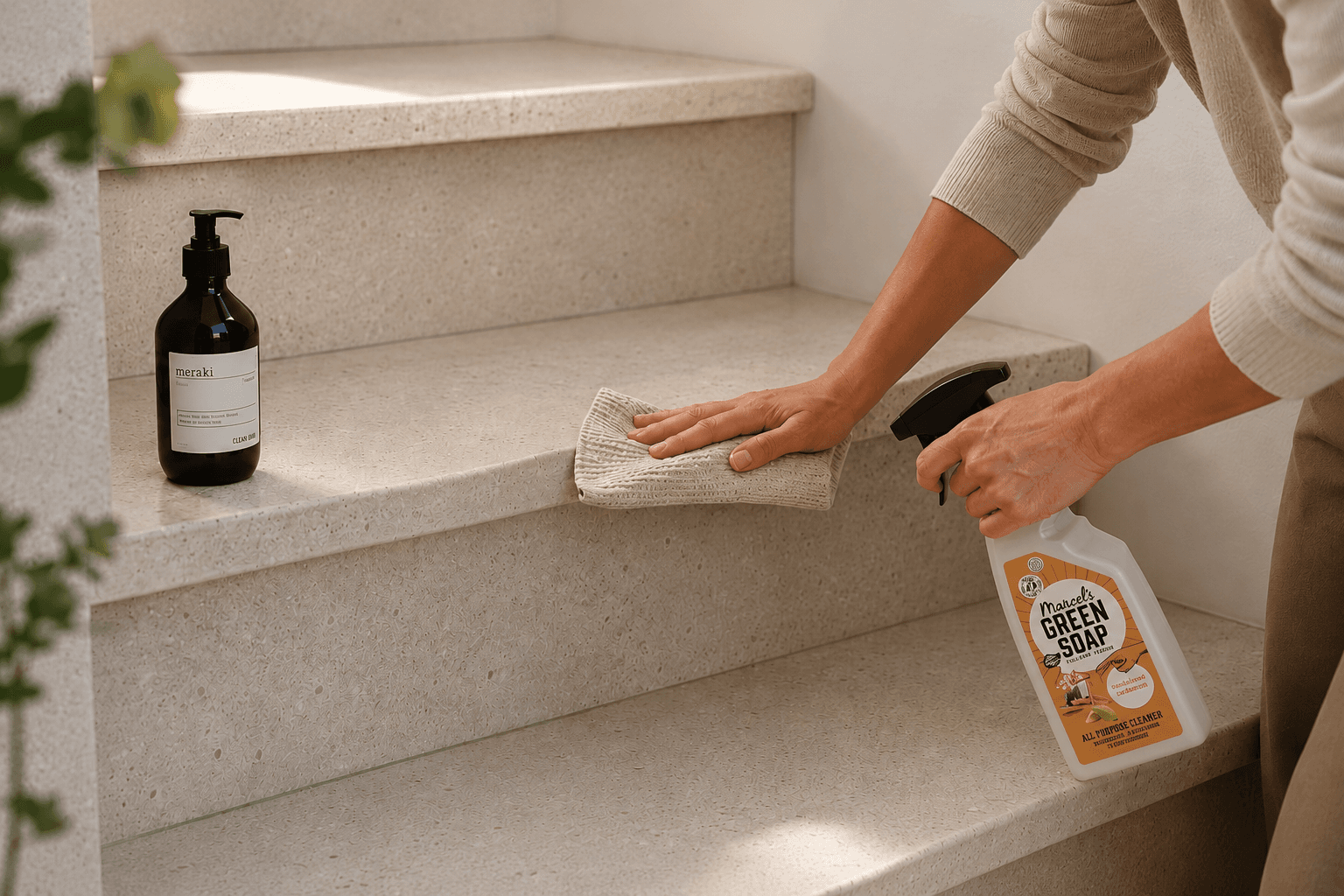
A well-renovated staircase stays beautiful when the maintenance is right. But not every material behaves the same — and the wrong approach accelerates wear, darkens joints, and compromises grip. A practical guide by system.
The aspect nobody asks about — but everyone notices
When choosing a stair renovation, almost nobody asks: how do I keep this clean? Colour, price, anti-slip — those are the conversations. Maintenance only comes up when the staircase looks older after two years than it did before the renovation. Dark wear lines in the wood grain. Dirt nesting along profile edges. An anti-slip strip that traps dust that no product can remove.
Maintenance is also a sustainability question. A staircase that needs intensive cleaning twice a week costs more time, more products, and more chemical load than one that needs a quick wipe weekly. And a staircase that looks worn before it is technically worn calls for replacement sooner than necessary.
This page explains how materials differ in maintenance behaviour, which products and methods work, and what is best avoided — by system and by usage situation.
What determines how easy a staircase is to keep clean?
Surface texture
Deep grain patterns and relief trap more dirt than closed mineral structures. The texture of the material determines how easy it is to keep clean.
Joints and profiles
Every loose element, edge, or transition is a potential dirt trap. Integrated systems without joints are fundamentally simpler in daily maintenance.
Anti-slip type
Loose strips and carpet collect dust and hair; integrated grip does not. The type of anti-slip partly determines the maintenance frequency.
Moisture resistance
Determines whether wet cleaning is possible without damage to the system. Not all materials are suitable for regular wet maintenance.
Coating and top layer
A UV-cured closed top layer allows dirt to adhere less readily than open or porous finishes. The quality of the top layer determines the daily maintenance burden.
The staircase that already looks tired after one year
You know the type. A staircase in a heavily textured wood look — "rustic oak", the brochure said. After six months, a dark band is visible along the wear line, right in the centre of every tread. Not because the staircase isn't being cleaned, but because the grain is too deep for an ordinary damp cloth. The dirt is in it, not on it.
With every clean, the surface layer becomes clean, but the grain retains its dark core. After two years the staircase looks worn, while the material is technically still perfectly fine. That is not a cleaning problem. That is a material choice that makes maintenance structurally harder.
A staircase that is easy to keep clean feels calmer every day than one that constantly demands attention.
The same pattern occurs with loose anti-slip strips: dust and hair accumulate along the edges. With carpet stair pads: moisture seeps in and never fully dries. And with aluminium transition profiles: dirt darkens the edge, and that dirt cannot be reached with any brush without damaging the coating.
How different materials respond to daily use
PVC and laminate — the grain that catches dirt
The 3D texture of PVC and laminate creates a realistic wood look — but has a downside. In PVC surfaces, dirt often gets trapped in the wood grain. Grease, cleaning residues, and fine dust nestle in the tactile grain and cannot be fully removed with an ordinary damp cloth. Wear lines quickly become visible on dark staircases: a dark band in the centre of every tread, exactly where every step falls.
Carpet and half-moon stair pads — the sponge
Carpet and textile mats act like a sponge: they absorb moisture, dust, hair, and bacteria. For sound absorption they are excellent; for hygiene, less so. Vacuuming removes surface dirt, but the fibres retain deeper dirt. With pets or allergies this becomes a real problem. Wet cleaning is limited; too much moisture damages the fixation and can promote mould growth.
Integrated mineral structure — closed and moppable
Recycled stone composite has a closed surface without deep grain or fibres. Dirt adheres less readily and does not penetrate the material. Damp wiping is always possible. This makes daily maintenance considerably simpler — and prevents the staircase from looking older than it is after just one year.
| System | Wet cleaning | Dirt accumulation | Stair nosing maintenance | Maintenance level |
|---|---|---|---|---|
| Carpet / stair pads | ✗ Limited | High — fibres retain dirt | Intensive | Intensive |
| PVC wood texture | ✓ Yes | Medium to high in grain | Sensitive | Regular |
| Laminate / HPL | With care | Medium | Sensitive | Regular |
| EverStep | ✓ Yes | Low to medium | Maintenance-friendly | Regular & simple |
| GripStep Home | ✓ Yes | Low | ✓ Fully integrated | Low |
| EverStep Solid | ✓ Yes | Very low | ✓ Integrated | Designed for sustained intensive use |
| GripStep Pro | ✓ Yes | Very low | ✓ Integrated | Designed for intensive professional daily use |
| Signature | ✓ Yes | Minimal — fully seamless | ✓ Seamless | Very low |
Why dirt accumulates around strips and profiles
Loose anti-slip strips often collect dust along their edges — this is one of the most underestimated cleaning problems in traditional stair renovation. Not the tread itself, but the transition between strip and tread is where dirt nests. Aluminium strips, rubber profiles, loose anti-slip profiles, and transition edges — each of these elements creates a horizontal niche where dust, sand, and hair settle.
Carpet half-moons retain hair and fine dust in their fibres. The mop catches on the edges. The vacuum misses the corners. And with wet cleaning, moisture seeps under the edge and dries slowly there — which can promote mould formation with intensive use or in damp stairwells.
Systems with loose elements — maintenance challenges
Dust edges along aluminium strips and profiles, hair and fine dust trapped in carpet pads, moisture under rubber edges when mopping, the mop catches on transition edges, dark discolouration along profile edges, and hard-to-reach joints with narrow strips.
Integrated systems — maintenance advantage
No loose elements where dust can settle, flat surface so mopping goes without catching, no dirt joints or edge formation, entire tread cleanable in one motion, grip is built into the material, and stair nosing and tread form one cleanable surface.
Which cleaning product works best?
Not every cleaning product is suitable for every stair surface. Aggressive products can damage coatings, affect anti-slip values, or leave a greasy residue that attracts new dirt. The choice of product is therefore also a choice for the lifespan of the system.
| Product | Residue formation | Environmental impact | Suitable for daily use | Suitable for mineral surfaces |
|---|---|---|---|---|
| Marcel's Green Soap | Low | ✓ Biodegradable | ✓ Yes | ✓ Yes |
| HG All-purpose cleaner | Medium | Traditional chemical | ✓ Yes | Limited |
| Dettol All-purpose cleaner | Medium | Higher chemical load | Limited | ✗ Not ideal |
| Ajax All-purpose cleaner | Medium | Average | ✓ Yes | Limited |
| Traditional green soap | High — greasy | Natural but greasy | ✗ Limited | ✗ Less suitable |
Marcel's Green Soap combines biodegradability with mild cleaning that leaves no greasy residue. The pH is suitable for modern coatings and mineral surfaces. Traditional green soap has a natural base but leaves a greasy layer that attracts dirt, and is less suitable for modern mineral surfaces or UV-cured coatings than the name suggests.
How to clean a staircase most effectively
The most effective cleaning is cleaning that is carried out regularly — not the intensive session that happens every two months while the staircase gets insufficient attention the rest of the time. Frequency is more effective than intensity.
01 — Vacuuming or dry wiping
Always start dry. Use a soft parquet brush, compact stair vacuum cleaner, or crumb brush. Remove loose dust, sand, and hair before wet cleaning — otherwise you smear the dirt around. A lightweight stick vacuum or cordless vacuum works better on staircases than heavy canister models.
02 — Damp wiping with the right cloth
Use a soft microfibre cloth or lightly damp microfibre mop. Microfibre draws dirt up rather than spreading it. Wring the cloth well — wet is too wet. On mineral surfaces, a lightly damp cloth with a few drops of Marcel's Green Soap is sufficient for weekly maintenance.
03 — Two-bucket method for more intensive cleaning
Use one bucket with clean water and cleaning product, one bucket for the soiled cloth or mop. Rinse the cloth after each tread in the second bucket. This prevents dirt from spreading from tread to tread and reduces streaking. Standard method in professional cleaning — also effective at home.
04 — Dry buffing if needed
On dark colours or glossy finishes, water streaks may be visible. A dry soft cloth immediately after damp cleaning prevents this. On matte mineral structures this is usually not necessary.
What to use — and what to avoid
Use
Soft microfibre cloth, lightly damp microfibre flat mop, soft parquet brush (vacuum cleaner), Marcel's Green Soap or neutral all-purpose cleaner, crumb brush or compact cordless vacuum, soft stair vacuum nozzle.
Avoid
Scouring sponges or scouring pads, steel wool or hard brushes, aggressive degreasing products, polish or gloss coatings, steam cleaner (too hot for coatings), excessive water — never allow standing water.
Why polish is not recommended for UV-cured systems
With many traditional floors, polish and gloss coatings are used to temporarily mask wear or extend appearance. For systems with SolidLux UV coating — such as EverStep Solid and GripStep Pro — this is not the recommended approach.
The UV curing process creates a very dense and closed top layer, so dirt adheres less readily than with open coatings, porous systems, or standard PVC top layers. Liquids do not penetrate, dirt particles sit on the surface rather than in it — and a damp cloth picks them up. That is the practical difference between an open and a closed surface structure.
A polish layer on a UV coating can build up unevenly, change the sheen in areas of higher load, and in the case of anti-slip systems: negatively affect the R-value by smoothing the surface. For professional maintenance partners in apartment buildings and commercial properties, the advice is: neutral cleaning, no build-up maintenance layers.
Matte structures show less dust and footprints
A practical advantage that few people consider in advance: high-gloss surfaces show fingerprints, footprints, and dust more quickly than matte structures. Every step on a glossy tread leaves a faint print. On a matte mineral structure this is far less noticeable — not because the surface attracts less dirt, but because the light reflection disperses it rather than concentrating it.
A closed surface needs no additional protective layer — it is the protective layer.
Why Signature has virtually no dirt joints
Signature is the only fully seamless system in the Omnistair collection. No transition profiles, no strips, no joints between tread and riser — the system is built up by hand as one continuous surface. What this means for maintenance is simple: there are no joints where dirt can accumulate.
That sounds like a design advantage. And it is. But it is at least as much a maintenance advantage. Every tread can be cleaned in one movement, from front to back, without the mop catching or dust corners remaining. No dark edge formation, no dirt joints, no zones that are harder to reach than the rest.
Signature — maintenance advantages
No transitions or profiles, one continuous cleanable surface per tread, no dirt joints between tread and riser, no edge formation along strips or aluminium profiles, no loose elements that the mop catches on.
SolidLux UV coating
Closed top layer — dirt adheres less readily. Compatible with all standard cleaning products without risk of joint damage. Immediately load-bearing after installation.
For VvE managers, cleaning companies, and facility managers
In stairwell applications, maintenance partly determines the Total Cost of Ownership. A system that requires less cleaning time, lower product costs, and looks less dated sooner delivers a demonstrable difference on an annual basis:
Choose systems with a closed surface structure: less dirt retention, less cleaning time
Brief cleaning staff: no aggressive degreasing products on UV-cured coatings
Use the two-bucket method for stairwell cleaning to limit the spread of dirt
No polish on certified anti-slip systems — this can affect the R-value and raise liability questions
Document the maintenance protocol as part of the building file — relevant for inspections and warranty claims
Integrated anti-slip without loose strips prevents the dirt accumulation along profile edges that is a recurring cleaning problem in traditional systems
Stair renovation maintenance — FAQ
That depends on use. In a family home with children or pets, dry wiping two to three times a week is realistic, supplemented by weekly damp cleaning. For a less intensively used staircase, weekly dry and fortnightly damp cleaning is sufficient. Frequency is more effective than intensity: regular short cleaning prevents the build-up of stubborn dirt.
Yes. All Omnistair systems are moisture-resistant and suitable for regular damp cleaning. Use a lightly damp microfibre cloth or mop. Avoid excessive water — standing water at the joint between tread and riser is never desirable, even with moisture-resistant systems.
That is the typical behaviour of deep wood-grain textures in PVC and laminate: dirt settles into the grain and cannot be fully removed with normal cleaning. It is not a quality defect but a property of the material. Closed mineral surfaces without deep texture show this behaviour considerably less.
Not recommended. The UV-cured SolidLux coating is designed as a self-contained protective layer — polish adheres less well to it, can build up unevenly, and may affect the certified R-value on anti-slip systems. Neutral cleaning is sufficient and keeps performance intact.
Carpet and textile structures are inherently absorbent: they retain dust, hair, moisture, and bacteria in the fibres. Vacuuming removes surface dirt but leaves deeper dirt behind. With pets or allergies this becomes a genuine hygiene problem. Integrated mineral anti-slip has no fibres and is moppable — a fundamentally different level of maintenance.
Almost no standard robot vacuum cleaner is suitable for stair treads — most only drive on flat floor surfaces. On wide landings or floor sections directly adjacent to the staircase, a compact robot can function. For the treads themselves, manual dry cleaning with a soft brush, hand-held vacuum, or compact cordless vacuum is always the most reliable method.
Marcel's Green Soap All-Purpose Cleaner — biodegradable, mild for UV-cured coatings and mineral surfaces, no greasy residue. Suitable for daily use in homes and professional environments. Traditional green soap (bar or liquid) leaves a greasy layer that attracts new dirt and is less suitable for modern stair surfaces.
Have the system assessed that suits your usage and maintenance preference
Maintenance starts with the material choice. An Omnistair specialist discusses your situation and advises which system best suits your daily use, cleaning method, and household situation.
This encyclopaedia page has been compiled by Omnistair on the basis of technical product information and practical knowledge. Cleaning product advice is indicative — always test new products first on a small, inconspicuous surface. Marcel's Green Soap is recommended for informational purposes; there is no commercial relationship with this brand. Omnistair is the manufacturer of the EverStep and GripStep system in recycled natural stone composite (patent NL2039653).