Renovating a creaking staircase
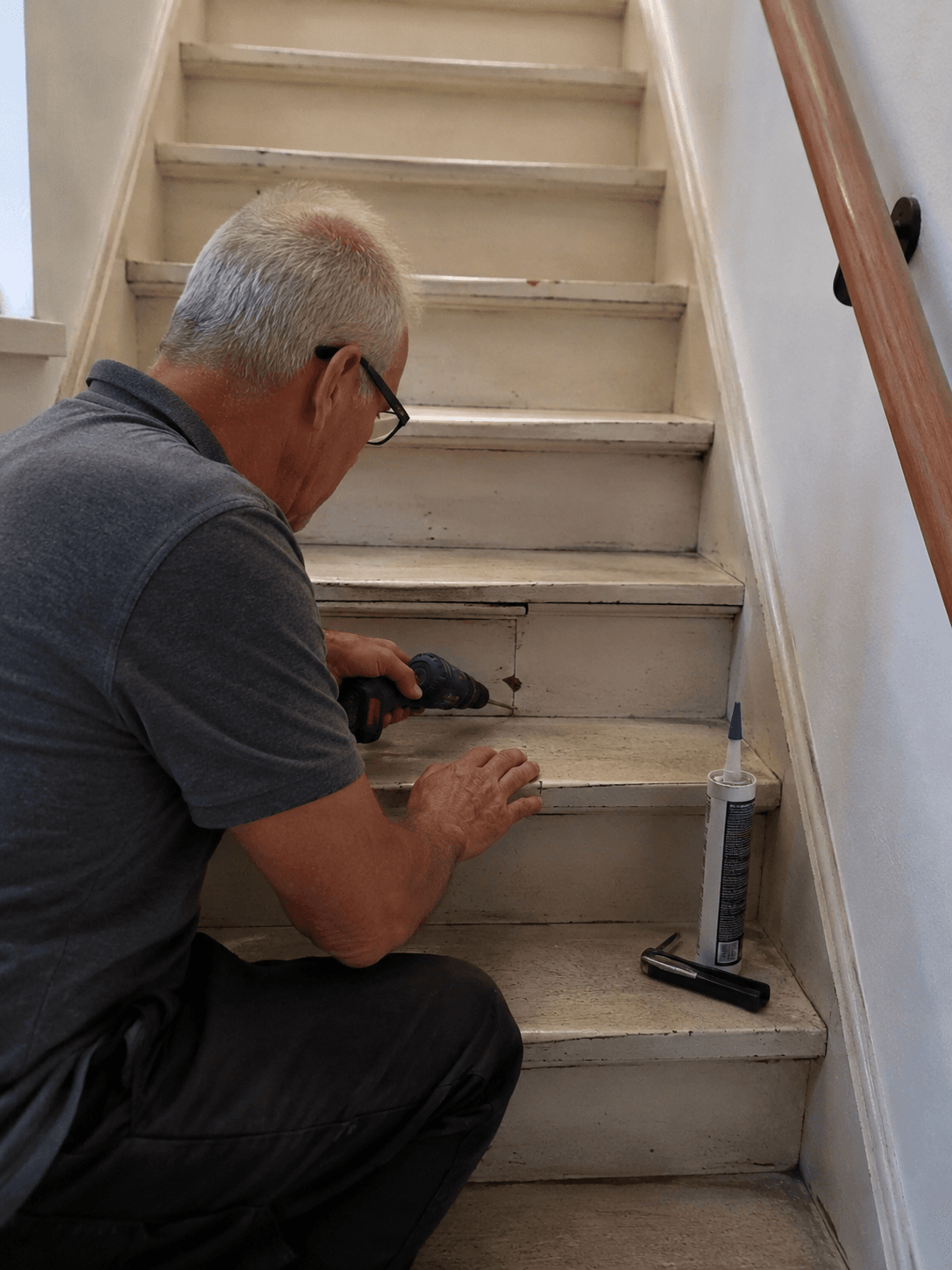
A creaking staircase is rarely just a noise problem — it is a structural problem. Those who do not understand this choose a renovation that sometimes makes the creaking worse rather than better.
The sound that keeps everyone awake at night
You know the feeling. The first step on the landing at two in the morning — and the staircase announces it to the whole house. Or the teenager who thinks they can sneak to the kitchen unnoticed. Or the morning when the baby has just fallen asleep and you try to come downstairs silently, tread by tread, and the staircase refuses to cooperate.
A creaking staircase is one of the most common irritations in Dutch homes. And one of the most misunderstood. Because most people think: new staircase, new finish, problem solved. In practice, the exact opposite sometimes happens. A thick overlay tread on an unstable structure acts like a soundboard. The noise is amplified, not dampened.
This page explains where creaking comes from, why some renovations make it worse, and what a lasting solution does differently at a structural level.
Why does a staircase creak — and what really works?
Cause
Almost always movement and friction between structural parts, not the surface itself.
New-build staircases
Staircases creak before handover due to construction moisture and early loading during the build.
Non-solutions
Talcum powder, carpet, half-moon treads, and thick overlay treads muffle sound but do not address the cause.
Mechanical fixation
Screwing through treads and risers reduces micro-movement structurally — the most direct approach.
Sealing
Fully sealing joints limits resonance and further moisture penetration into the structure.
Sound-dampening adhesive bonding
Absorbs vibrations and distributes load across the full surface — no point loading.
Why a staircase creaks — the three most common causes
Creaking almost always results from movement. Not from the material, not from the finish, but from micro-movement between structural parts that should be resting quietly against one another. That movement always has a cause — and that cause determines the solution.
Loosening joints
Treads, risers, and stringer panels moving minimally relative to one another. With every step, wood rubs on wood — producing the familiar squeak. Often aggravated by nails or staples that have less holding power than screws.
Construction moisture & wood movement
Wood moves with fluctuating humidity. New-build staircases are especially vulnerable: they are placed in a damp environment while the roof is still open. This builds up stress before the first resident sets foot on the stairs.
Poor fixation
Many modern staircases are assembled quickly with staples instead of screws. More efficient to produce, but technically far weaker. A staple barely provides structural hold and can pull loose under prolonged load.
Why new-build staircases already creak before handover
This is a story that many new homeowners only hear afterwards. The staircase was installed in week three of the build — while the roof was still open, the floor was still being poured, and the walls were still wet. The reason is practical: construction workers must be able to get upstairs safely under health and safety regulations. So the staircase goes in early.
That staircase is then exposed to months of construction moisture, rain, temperature fluctuations, and daily loading. The wood moves, warps, and builds up stress. Joints that would be tight in dry conditions become looser. By the time the residents move in, the first creak points are already present — invisible, but demonstrably there.
Many creaking staircases are not old. They got wet at the wrong moment.
This is also why a new-build staircase that creaks from day one is not "normal" but a signal that the structural joints need extra attention before any renovation is carried out.
Why thick overlay treads sometimes make creaking worse
The reasoning seems logical: a thicker tread is a sturdier tread. But that only holds true if the underlying structure is already stable. On a moving staircase, a thick overlay tread behaves differently from what you expect — and sometimes in a way that is downright counterproductive.
The soundboard effect
Thick systems with a hollow build-up or air chambers act as a resonance chamber. The sound is not absorbed but amplified — just as a hollow guitar body amplifies the sound of a string. The staircase may afterwards sound not quieter but noticeably louder, even if the material itself is of good quality.
The lever effect of heavy stair nosings
Traditional systems often have heavy, protruding stair nosings. With every step, that weight pulls at the front of the tread — a classic lever principle. On a tread that already moves slightly, this lever effect amplifies the micro-movement at the joint. Existing creak points become more active, and new stress points can arise exactly where the original structure was already vulnerable.
Cutting back the stair nose — an irreversible mistake
Many traditional systems require the existing stair nosing to be cut back or sawn off. This makes the build-up possible — but it also weakens the tread at its most heavily loaded point. The front of the tread, which absorbs the most force with every step, has less material to work with after being cut back. On an already-moving staircase, that is not an improvement.
| Method | Effect on creaking | Drawback |
|---|---|---|
| Talcum powder / lubricant | Temporarily less friction | ✗ Structure keeps moving — problem returns |
| Carpet / half-moon treads | Limited sound muffling | ✗ No structural solution — cause remains |
| Painting | ✗ No effect | Staircase keeps moving, paint wears at creak points |
| Thick overlay treads | ✗ Unpredictable — sometimes worse | Soundboard effect, lever action, additional stress |
| Mechanical fixation + sealing | ✓ Structurally effective | Requires good workmanship and preparation |
| Ultra-thin full adhesive bonding | ✓ Stabilising | Works best in combination with prior fixation |
The Omnistair stabilisation method — four steps
A lastingly quiet staircase starts not with the new surface but with the structure beneath it. The method below works from the inside out: stabilise first, then renovate.
01 — Structural inspection
Assessment of treads, risers, stringer panels, and all existing fixings. Which joints are moving? Where are the loose parts? What is causing the creaking — moisture, poor installation, or worn fixings? Without this analysis, every subsequent step is guesswork.
02 — Screws instead of staples
Where needed, joints are re-fastened with screws — through the top of the tread firmly into the riser, and through the riser into the tread structure. Screws pull components tightly together and maintain that tension under prolonged load far better than nails or staples.
03 — Full sealing
Gaps and transitions between treads, risers, and stringer panels are fully filled and sealed. This limits further micro-movement, reduces resonance, and blocks moisture ingress. A joint that vibrates makes noise. A joint that is filled does not.
04 — Sound-dampening structural bonding
The ultra-thin renovation system is fully bonded across the existing surface — not at points but across the full area. The sound-dampening adhesive fills micro-irregularities, distributes load evenly, absorbs vibrations, and creates a stable base that additionally stiffens the existing tread.
Why ultra-thin systems work differently at a structural level
An ultra-thin system of 4.3 mm adds minimal weight to the existing tread. There is no lever effect, no extra mass at the stair nosing, no hollow soundboard. The system connects directly to the existing surface and is fully bonded — meaning it serves simultaneously as a new finish and a stabilising layer.
Recycled stone composite has high rigidity. That rigidity contributes to the overall stiffness of the tread once the system has been bonded. A wooden tread that flexes slightly under load does so less when a stiff composite material is fully glued on top of it. Less flex means less micro-movement at the joints — and that is precisely where the creaking comes from.
Moreover, the original stair nosing remains intact: no cutting back, no weakening of the most heavily loaded point. The structure stays as it was designed — only the walking surface changes.
The best stair renovation system is the system that strengthens the structure rather than burdening it further.
When silence makes the difference
A quiet staircase only becomes noticeable when it was there and is now gone. The morning after the renovation, when the coffee machine is on but the staircase is not joining in for the first time. The evening when the children go upstairs without you hearing them. The night when nobody is startled awake by two footsteps on the landing.
In apartments, this difference is even greater. Impact sound travels through structures. A creaking staircase in the hallway announces every movement to the neighbours above and below. Sound-dampening adhesive bonding and a stable build-up are in that context not a comfort feature but a basic requirement — including from a VvE (owners' association) perspective, where noise disturbance between residents can become an ongoing management problem.
For installers, contractors, and project managers
Creaking at handover of a stair renovation is almost always preventable — provided the preparation is carried out correctly. Most complaints after renovation can be traced back to one of three mistakes: insufficient fixation before the renovation, skipping the sealing phase, or using a system with hollow build-up on an already-moving structure.
Always inspect the structural condition of the staircase before any other work begins
Replace staples with screws in all existing joints that show movement
Fully seal all joints and transitions before the new system is installed
Use sound-dampening adhesive — standard construction adhesive does not have the same vibration-absorbing properties
Avoid thick systems with hollow build-up on staircases that already move — the soundboard effect is real
Document the stabilisation step for the client: for new-build staircases, this may be relevant for warranty claims against the contractor
Systems that stabilise and renovate
All Omnistair systems are fully bonded using sound-dampening adhesive over the existing tread surface. The ultra-thin build-up avoids the lever effect and soundboard problem of thick systems. The high rigidity of recycled stone composite contributes to the overall stiffness of the tread after installation.
EverStep
Ultra-thin overlay treads of 4.3 mm. Fully bonded with sound-dampening adhesive. Integrated stair nosing — no cutting back required. Stiffer tread through the rigidity of stone composite. Stone Naturel, Stone Blend, Terrazzo.
GripStep Home
Integrated anti-slip with sound-dampening structural bonding. For wooden staircases that need to become both safer and quieter. Suitable for DIY installation — including preparation with screws and sealant.
EverStep Solid
Heavy-duty renovation for intensive use. Sound-dampening bonding, NEN 7909 anti-slip, fire class Bfl-s1. For stairwell staircases where impact sound between residents is a management problem.
GripStep Pro
For apartments, concrete staircases, and project-scale applications. Certified anti-slip, sound-dampening installation, Taber-tested to 10,000 cycles. Also suitable for outdoor staircases.
Creaking staircase — FAQ
Almost always. The cause almost always lies in moving joints, loose parts, or tension in the structure — not in the material itself. With mechanical fixation, sealing, and sound-damping full bonding, creaking can in most cases be greatly reduced or completely eliminated. Exception: if the load-bearing structure of the staircase is structurally compromised, repair of the structure must come first.
Staircases are installed early in the construction process so that workers can safely access upper floors. During this period the staircase is exposed to construction moisture, rain, and temperature fluctuations — while the roof is not yet closed. The wood absorbs moisture, begins to move, and builds up tension. By the time of handover, the creak points are already present. This is not a manufacturing defect but an unavoidable consequence of the construction sequence.
No — not structurally. Carpet and mats dampen the sound somewhat at the surface but do not resolve the underlying cause. The structure keeps moving, the wood keeps working, and the friction that produces the noise is still there. As soon as the mat is removed, the creaking is as present as ever.
A screw has a mechanical clamping action: it actively draws two components together and maintains that tension even under prolonged load. A nail or staple works passively — it holds components in place but does not fill the play. On a staircase that is already moving slightly, a nail or staple loses its grip faster than a screw.
Often yes — provided the stabilisation steps are carried out correctly before the renovation. Full bonding with sound-damping adhesive absorbs vibrations and eliminates the remaining micro-movement between the tread and the renovation system. The high rigidity of stone composite contributes to the overall stiffness of the tread. Impact sound, structural creaking, and resonance can reduce significantly.
Thick systems with hollow construction or air chambers act as a resonance space — sound is amplified rather than absorbed. Heavy stair nosings create leverage with each step, placing additional load on moving joints. And if the stair nose has to be cut back, that weakens the tread at precisely its most loaded point. On a structure that is already moving, all those effects are cumulative.
The mechanical fixation step — screwing joints — is doable for a capable DIY enthusiast if the staircase is accessible. Sealing gaps with caulk can also be carried out independently. GripStep Home is then designed for self-installation. For a good diagnosis of the cause of the creaking, it is advisable to have a specialist look first — not every staircase responds the same way to the same approach.
Have the cause of your creaking staircase assessed and the right solution identified
Creaking always has a cause. An Omnistair specialist assesses the structural condition of your staircase and advises which approach — stabilisation, renovation, or a combination — is most effective.
This encyclopaedia page has been compiled by Omnistair on the basis of technical knowledge about staircase structures and practical experience with stair renovation. The stabilisation method described is indicative — the correct approach always depends on the specific structural condition of the staircase. Omnistair is the manufacturer of the EverStep and GripStep system in recycled natural stone composite (patent NL2039653).