GripStep half-moons
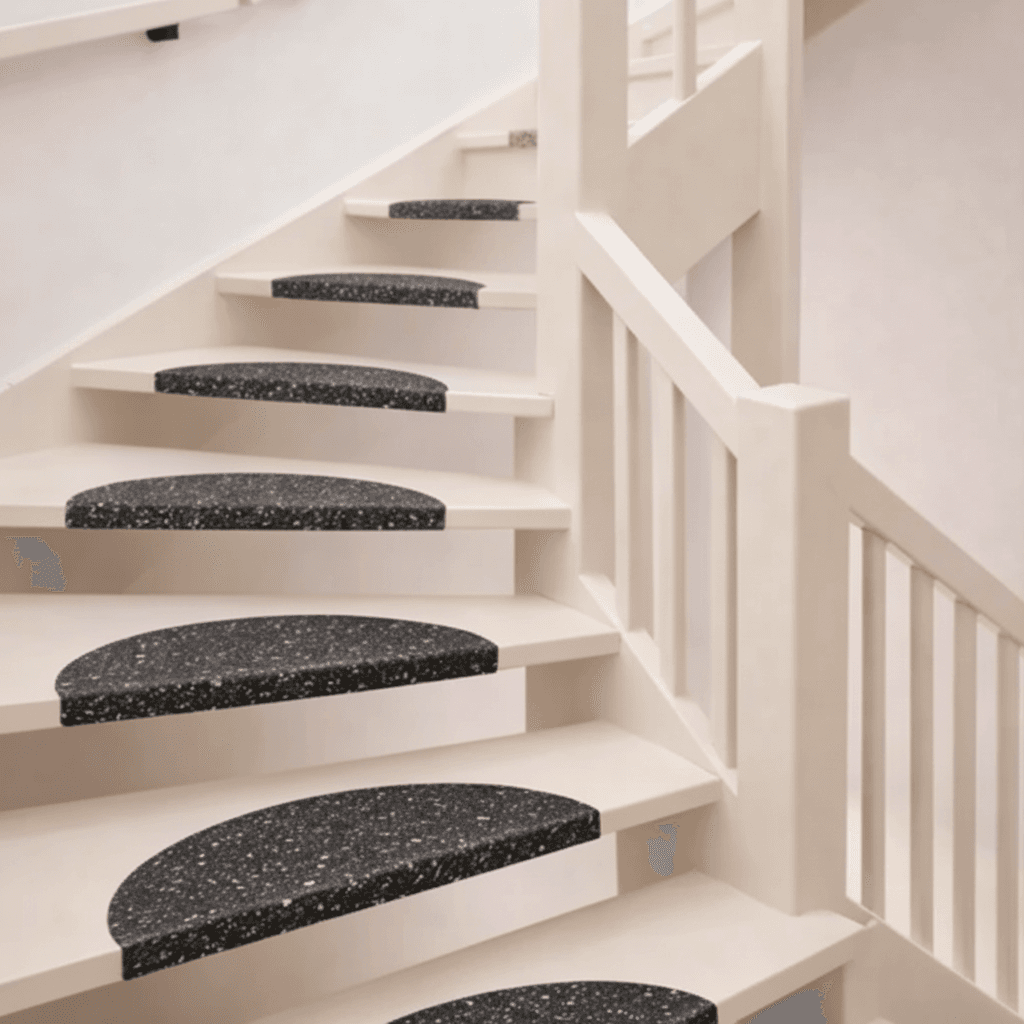
Stair pads, Stufenmatten, and loose strips have been popular for decades. But modern integrated anti-slip systems work in a fundamentally different way — and that difference is most visible at the point that matters most: the stair nose.
A familiar solution — but not always the safest
Anyone with a wooden staircase that feels a little slippery quickly thinks of half-moons (the smile-shaped anti-slip notches characteristic of older Dutch staircases). They are available at every DIY store, cost little, and can be fitted in an afternoon. In the Netherlands, Belgium, and Germany, stair pads — also known as Stufenmatten or stair treads — have been the standard solution for a slippery staircase for decades.
But there is something that is rarely said about stair pads: the grip sits in the centre of the tread. Exactly the part where the foot is best supported. Not on the stair nose — the point where most falls begin, where every step makes the transition from tread to tread, and where a mat simply stops.
Modern integrated anti-slip systems are designed from a different principle: not grip on part of the tread, but grip across the full walking surface — including the stair nose. This page compares both approaches honestly, without declaring either a winner from the outset.
Where does the real difference lie?
The five defining differences
Stair nose
Half-moons leave the stair nose exposed. Integrated systems protect the full walking surface including the nose — precisely the point where most falls begin.
Maintenance
Carpet and fabric absorb dirt, hair, and moisture. Stone composite has a closed surface — moppable, moisture-resistant, no fibres.
Fixation
Tape and adhesive strips can come loose and curl up. Structural bonding provides a permanent connection without loose edges.
Service life
Mats visibly wear and discolour over the years. Integrated grip is in the material itself — does not wear away with the surface.
Certification
Stair pads rarely carry an official anti-slip classification. Integrated systems can achieve R11 and NEN 7909.
The moment when a mat is not enough
Imagine: you have a wooden staircase that feels just a little too slippery on early mornings in socks. You buy halve maantjes. They are on within an hour, look neat, and the grip is noticeably better — on the centre of the tread. Two years later, the edges start to curl. The dog has half-pulled the third tread loose. On the stair nose itself, where your foot descends every time, there is still no protection.
That is not the failure of a poor product. That is the limitation of a system that was not originally designed for stair safety, but for comfort and sound dampening. A half-moon covers what it covers. No more.
Grip that stops before the stair nose protects the wrong part of the tread — exactly where most slip incidents begin.
Try the paper test: place a sheet of paper on the stair nose and step on it. Does it slide away immediately? Then the greatest risk is not in the centre of the tread, but at the nose — where your foot makes the transition during descent. That is precisely the part a half-moon does not cover.
Why they are popular — and where the limits lie
Half-moon stair pads are not inherently a bad choice. They have real advantages that explain why they have been sold for decades. But those advantages come with limitations that are rarely stated in the product description.
Advantages
Lowest purchase price of all solutions. Easy to fit yourself. Immediately noticeable sound dampening. Protects the wooden tread from scratches. Wide range of materials and colours. Removable without damage when correctly fixed.
Limitations
Stair nose remains unprotected. Edges can come loose and curl. Carpet and fibres absorb dust and hair. Harder to keep clean with pets or allergies. Rarely a certified anti-slip level. Wear and discolouration visible after years. Tape or adhesive residue can damage lacquer.
Common sizes — the Netherlands, Belgium, and Germany
Not every country uses the same stair dimensions. On narrow Dutch winder staircases, large German sizes can overhang or fall off the tread edge — measuring carefully is not a detail but a safety requirement.
| Size | Dimensions | Commonly used in |
|---|---|---|
| Standard | 56 × 17 cm | Netherlands |
| Large | 62 × 19 cm | Benelux |
| German size (Stufenmatte) | 65 × 22 cm | Germany |
German homes have on average wider treads and less steep stair angles — hence the larger sizes. On narrow Dutch quarter-turn staircases, this difference is not cosmetic but structurally relevant.
Half-moons vs integrated anti-slip — side by side
The comparison below is based on the most defining characteristics for daily use, safety, and maintenance. It is intended to be objective — both solutions have their area of application.
| Feature | Half-moons / Stufenmatten | GripStep integrated anti-slip |
|---|---|---|
| Installation | Self-adhesive tape or adhesive strips | ✓ Structural bonding |
| Stair nose | ✗ Remains unprotected | ✓ Fully integrated |
| Anti-slip | ✗ Depends on fabric and wear | ✓ Integrated R10 / R11 |
| Maintenance | ✗ Vacuuming; fibres retain dirt | ✓ Moppable, moisture-resistant |
| Hygiene | ✗ Absorbs dust, hair, and moisture | ✓ Maintenance-friendly surface |
| Sound dampening | ✓ Good with carpet and velour | Depends on substrate |
| Loose edges | ✗ Possible with wear or moisture | ✓ Not applicable |
| Fire class | ✗ Often unknown or uncertified | ✓ Bfl-s1 possible (GripStep Pro) |
| Certified anti-slip | ✗ Rarely | ✓ NEN 7909 possible |
| Intensive use | ✗ Limited — wear becomes visible | ✓ Professionally applicable |
| Purchase price | ✓ Lowest entry point | Higher — longer service life |
What hygiene and maintenance mean in practice
A stair pad made of carpet or velour looks different after just one day compared to the first day. Dust particles sink into the fibres. A dog that climbs the stairs leaves hairs that cannot be removed with a vacuum cleaner. A child running upstairs with muddy shoes leaves a trail through the mat that is difficult to remove with water and soap.
That sounds more dramatic than it is — but for people with allergies, pets, or an intensively used staircase, it is a real objection. Stair mats are inherently absorbent material. That is simultaneously their strength (sound dampening) and their weakness (maintenance).
Integrated systems in stone composite have a closed surface. There are no fibres, no seams, no edges where dirt can creep in. Cleaning is the same as wiping a tiled floor — damp cloth, done. That is not a marginal advantage. For parents with young children, people with pets, or managers of a communal stairwell, it is a fundamentally different maintenance standard.
The stair pad dampened the noise. But it was only after the replacement that we noticed how easy a staircase can be to keep clean.
When to choose half-moons — and when not to?
Half-moon stair pads are still a good choice when
Budget is the primary factor and the staircase is lightly used. In a classic interior where the warm look of carpet or sisal fits. When a temporary solution is needed — for example in a rental property or a staircase that will be fully renovated in the near future. And for staircases that are not heavily loaded and where sound dampening outweighs long-term grip guarantee.
Integrated anti-slip is the better choice when
Safety is the priority — with elderly people, children, or pets. When the staircase is used intensively and maintenance should be as straightforward as possible. In apartments and VvE (owners' association) stairwells where certification, liability, and intensive use are factors. When a modern look without visible strips, mats, or profiles is desired. And for staircases in hospitality, healthcare, or public buildings where certified anti-slip and fire class are required.
| Situation | Half-moons | GripStep integrated |
|---|---|---|
| Budget renovation, temporary | ✓ Suitable | Not necessary |
| Home, normal use | Possible | ✓ Better in the long term |
| Elderly or fall risk | ✗ Limited — nose unprotected | ✓ Full walking line |
| Pets | ✗ Intensive maintenance | ✓ Moppable |
| Allergies | ✗ Fibres retain dust | ✓ Closed surface |
| Apartment complex / VvE | ✗ Not suitable | ✓ Certified possible |
| Hospitality, healthcare, commercial | ✗ Not suitable | ✓ R11 / NEN 7909 |
| Concrete exterior staircase | ✗ Not suitable | ✓ GripStep Pro |
How integrated anti-slip differs technically
GripStep Home and GripStep Pro are both constructed from recycled stone composite — a material with a MOHS value of 6–7. This means the surface withstands the sand and particles that come in on shoe soles every day — the same sand that causes laminate and PVC to wear down over the years.
The anti-slip is not a layer on top of the material, but part of the material composition itself. That has a direct consequence: the grip does not wear away as the surface ages. There is no coating that wears off, no texture that becomes smooth. What you see and feel on day one is what remains after fifteen years.
GripStep Home
For homes and apartments. Integrated anti-slip across the full walking surface including stair nose. Moppable, moisture-resistant, suitable for DIY installation. Available in Stone Naturel, Stone Blend, and Terrazzo.
GripStep Pro
R11 / NEN 7909 certified. Fire class Bfl-s1. Taber-tested to 10,000 cycles. For hospitality, healthcare, commercial property, and public buildings. Also suitable for concrete and exterior staircases.
For VvE managers, architects, and installers
Loose stair mats — even of high quality — are legally vulnerable in communal traffic areas. In the event of an incident, an insurer will ask for certified anti-slip performance, demonstrable fire classification, and maintenance protocols. A stair mat almost never has that documentation.
Always use systems with a demonstrable test report for anti-slip (R-value or NEN 7909) on communal staircases
Check that the system meets fire class Bfl-s1 for use in escape routes and apartment buildings
Loose mats in a stairwell are a maintenance risk: who checks whether the edges are still fixed?
Integrated systems eliminate the management burden that arises with loose mats
For project-scale applications: request the Taber wear test report for long-term performance assurance
Why the German market views stair safety differently
Germany has one of the largest markets for Stufenmatten in the world. Brands such as Floordirekt and tretford are leading players — tretford in particular due to its use of wool and cashmere goat hair, with a strong positioning on sustainable interior applications.
But a growing shift is also visible. Precisely in Germany — a market that traditionally places great value on certification, material testing, and technical substantiation — demand for integrated anti-slip systems is increasing. Not as a replacement for the comfort of carpet, but as an answer to a different question: what does a system perform after ten years of intensive use in a Mehrfamilienhaus?
In apartment complexes, public buildings, and care institutions, Stufenmatten have long since ceased to be considered standard. The requirements for fire classification, anti-slip standards, and maintenance management make loose mat solutions practically unsuitable in that context. That is exactly the segment for which GripStep Pro is designed.
Half-moons vs anti-slip — FAQ
That depends on the material, the fixation, the wear, and the maintenance. On a well-fixed and well-maintained pad, carpet or velour provides grip on the centre surface of the tread. But the stair nose — the most critical point when descending — remains unprotected. Loose or curling edges can also present an active trip hazard.
A half-moon is a loose mat that is stuck or glued onto the tread. GripStep is a thin element of recycled stone composite that is structurally bonded to the tread, with grip that continues across the full stair nose. The material composition, installation method, maintenance, and possible certification are fundamentally different.
Yes — Germany has a large market for Stufenmatten with players such as Floordirekt and tretford. At the same time, a clear shift towards certified integrated anti-slip is visible, particularly in apartment complexes, care institutions, and public buildings where stair mats no longer meet the requirements for fire classification and anti-slip standards.
Yes. GripStep Home is designed for quick installation on existing staircases without routing, chiselling, or specialist tools. Thanks to its ultra-thin construction and structural bonding, the system is also accessible to DIY enthusiasts with basic experience — and considerably more stable than a self-adhesive stair mat.
No — quite the opposite. Carpet and fibres retain dust, hair, and moisture. Integrated systems in stone composite have a closed surface without fibres or seams. Wiping with a damp cloth is sufficient. That is simply not possible with a velour or sisal stair mat.
Yes. GripStep Pro is also applied to concrete staircases in apartment complexes, commercial property buildings, gallery staircases, and exterior staircases. The structural bonding works on concrete, wood, and other stable substrates. For exterior staircases, GripStep Pro is the most suitable choice due to its closed surface structure and moisture resistance.
At a low budget ceiling, in a classic interior where the warmth of carpet fits, or as a temporary solution for a lightly used staircase. For comfort and sound dampening on a low-load staircase, stair pads remain a low-threshold option. As soon as safety, hygiene, or intensive use come into play, the balance shifts towards integrated systems.
Have the right anti-slip solution for your staircase and usage assessed
Not every staircase requires the same solution. An Omnistair specialist assesses your situation and advises which system — or combination — is most suitable.
This encyclopaedia page has been compiled by Omnistair on the basis of market overview and technical product information. Brands such as Floordirekt, tretford, and Micostep are mentioned purely for informational purposes as market context — no commercial relationship exists with these parties. Omnistair is the manufacturer of the GripStep and EverStep system in recycled natural stone composite (patent NL2039653).